Three cards, one pot, and a decision window that often lasts less than ten seconds - that's the entire arithmetic of Teen Patti. Yet within that narrow frame sits one of South Asia's most enduring card games, a title that has moved from crowded family living rooms during festival nights to mobile apps with millions of active tables running at any given moment. The simplicity is deceptive. Beneath the three-card deal lies a layered system of hand rankings, betting psychology, and regional variants that can trip up even experienced poker players who assume the two games behave alike.
This guide exists because most explanations of Teen Patti either oversimplify the rules into a paragraph or bury newcomers in jargon borrowed from poker terminology that doesn't map cleanly onto the game. Before betting a single chip, it helps to understand the full mechanics - the official teen patti rules cover everything from blind play to side shows, and grasping them early prevents costly mistakes at the table. What follows breaks the game down piece by piece: how hands are ranked, how the popular variants change strategy, and how betting decisions separate players who fold too early from those who bleed chips chasing bad hands.
By the end, a first-time player should be able to sit at a table - physical or digital - and play with the same confidence as someone who grew up with the game.
How to Play Teen Patti: Core Rules Explained
Teen Patti, which translates roughly to "three cards," uses a standard 52-card deck with no jokers in its traditional form. Anywhere from three to six players can join a single round, each contributing a fixed amount - called the boot - to the pot before any cards are dealt. The dealer then distributes three cards face-down to every player, and the round of betting begins immediately, moving clockwise around the table.
Setting Up the Table and the Boot Amount
Before the first card touches the table, players agree on the boot value, which becomes the minimum stake for the round. This amount is typically small and symbolic, but it sets the scale for every subsequent bet. A higher boot means a faster-growing pot and, consequently, sharper decision-making pressure once betting rounds intensify.
The Deal and Turn Order
Cards are dealt one at a time, face-down, until each player holds three. No one reveals their cards unless they choose to "show" during a side show or at the final confrontation. Turn order proceeds clockwise, and each player must act - bet, raise, or fold - when it becomes their turn. There is no skipping a turn once betting has started.
Blind vs. Seen Play
This is where Teen Patti diverges sharply from most Western card games. A player can choose to stay "blind," meaning they bet without looking at their own cards, or go "seen" after checking their hand. Blind players bet at a lower fixed amount, while seen players typically must bet at least double what a blind player wagers at that stage. Staying blind is a legitimate tactic - it disguises intent and keeps betting costs lower, which is a detail every guide to teen patti rules for beginners should stress early, since it directly affects bankroll management.
Winning the Round
A round ends when only one player remains after others fold, or when two players left in the hand agree to a "show," comparing cards to determine the winner. The player holding the higher-ranked hand takes the entire pot. If everyone folds except one player, that player wins without ever revealing their cards - a detail that makes bluffing and blind play genuinely powerful tools.
Teen Patti Hand Rankings You Must Memorize
Understanding teen patti hand rankings is non-negotiable. Betting decisions are meaningless without knowing what beats what, and the order here differs from standard poker rankings because there are only three cards to work with, not five.
The Complete Ranking Order
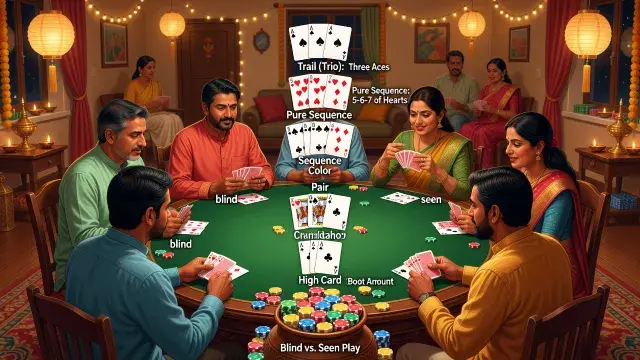
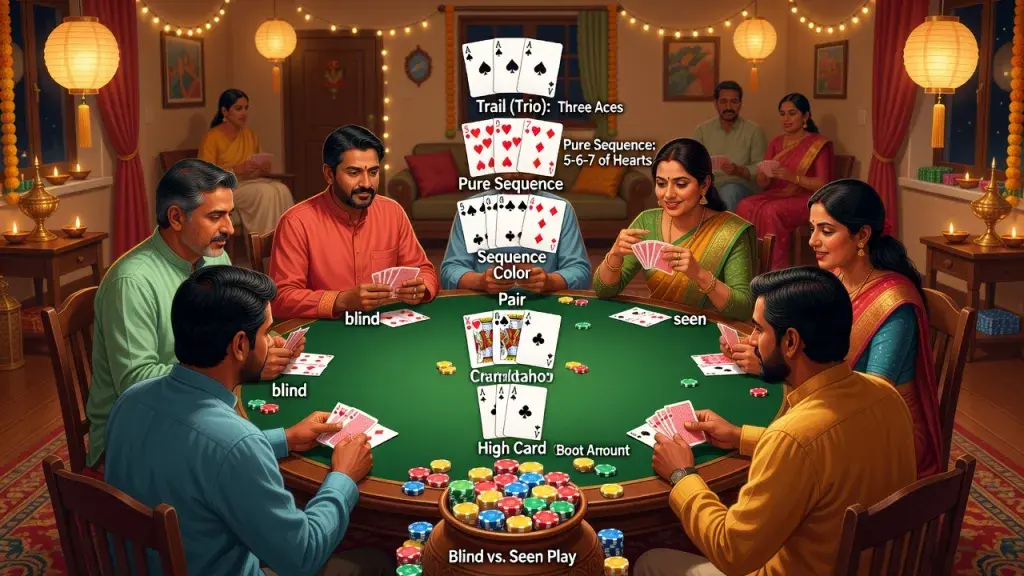
- Trail or Trio (three cards of the same rank) - the highest possible hand, with three Aces topping the list
- Pure Sequence (three consecutive cards of the same suit) - also called a straight flush
- Sequence (three consecutive cards of mixed suits) - a regular run
- Color (three cards of the same suit, not in sequence) - equivalent to a flush
- Pair (two cards of matching rank plus one unmatched card)
- High Card (no matching rank, suit, or sequence) - ranked by the highest single card
Why Three-Card Math Changes Everything
With only three cards in play, certain hands become statistically rarer or more common than their five-card poker counterparts. A Trail, for instance, is far less likely to appear than three-of-a-kind in poker, which is why it sits at the very top. Pairs, by contrast, show up frequently enough that experienced players treat a single pair as a modest, not dominant, advantage.
Comparing Equal Hand Types
When two players hold the same category of hand - two Sequences, for example - the tiebreaker goes to the highest card in the sequence. If both hands are genuinely identical in rank (a rare scenario with a single deck and no wild cards), the pot is typically split. Knowing these tiebreak rules prevents disputes at the table and builds the confidence needed to call a show at the right moment.
Teen Patti Variations and Rules Worth Knowing
Few card games spawn as many regional and house-rule variants as Teen Patti. Each variation tweaks either the deal, the wild card system, or the betting structure, and switching between them without warning can catch a beginner off guard.
Muflis (Lowball Teen Patti)
In Muflis, the entire hand ranking flips: the lowest hand wins instead of the highest. A Trail of Aces, normally the best possible hand, becomes the worst hand a player can hold. This inversion forces a complete recalibration of strategy, since hands players instinctively want to fold in standard play suddenly become the ones worth backing.
AK47 and Wild Card Variants
This variant designates Aces, Kings, 4s, and 7s as wild cards, meaning they can substitute for any card to complete a stronger hand. Wild card variants dramatically increase the frequency of Trails and Pure Sequences, which changes betting behavior - players tend to stay in hands longer since the odds of a strong combination rise sharply.
Joker Teen Patti
A joker is drawn randomly each round and declared wild for that deal only. Because the wild card changes every hand, players cannot rely on memorized odds from previous rounds, which keeps the game unpredictable and rewards adaptability over rote memorization.
Community Teen Patti (Best of Four or Five)
Borrowing a concept from poker, this variant deals additional community cards face-up in the center of the table, and players combine their own hand with the shared cards to form the best possible three-card combination. It slows the pace slightly but adds a layer of visible information that changes how aggressively players bet.
Grasping these teen patti variations and rules matters because casual games rarely stick to the traditional format alone - house rules often blend two or three variants into a single session, and a player unfamiliar with the changes will misjudge hand strength badly.
Teen Patti Betting Strategy for Consistent Play
Strong teen patti betting strategy rests less on memorizing odds and more on reading betting patterns, managing a limited bankroll across many small rounds, and knowing when a fold protects more value than a call.
Blind Play as a Deliberate Tactic
Staying blind isn't just cheaper - it's informationally powerful. Opponents cannot read your confidence level because you haven't looked at your own cards, which makes your bets harder to interpret. Skilled players sometimes stay blind even with strong instincts about the table, purely to keep the cost of staying in low while gathering information on how others bet.
Reading Opponents Through Bet Sizing
A sudden jump in bet size from a previously cautious player often signals a strong hand, particularly a Trail or Pure Sequence. Conversely, players who consistently match the minimum bet round after round are frequently holding weak hands and hoping to see a cheap showdown. Pattern recognition, built over repeated sessions, is worth more than any fixed formula.
Bankroll Discipline Across a Session
Because boot amounts and bet increments are small individually, it's easy to underestimate how quickly a losing streak drains a stack. Setting a firm loss limit before sitting down - and walking away when it's hit - protects against the compounding effect of chasing losses with increasingly desperate calls.
When to Call a Side Show
A side show lets a player privately compare hands with the person who bet immediately before them, without involving the rest of the table. This move is useful when a player suspects the preceding bettor is bluffing but wants to avoid the higher stakes of a full show. Used sparingly, it's one of the sharper tools in a seasoned player's arsenal.
Common Mistakes Beginners Make
Overvaluing a Single Pair
New players often treat any pair as a strong hand worth aggressive betting, forgetting that pairs are common and easily beaten by a Color or Sequence. Betting big on a low pair against multiple opponents who've stayed in the hand is a frequent way to lose a stack early.
Staying Seen Too Early Without Reason
Switching from blind to seen status raises the required bet immediately. Beginners sometimes do this out of impatience rather than strategic necessity, paying a premium for information they didn't need yet.
Ignoring Table Size and Its Effect on Hand Strength
A hand that looks strong at a three-player table can become mediocre at a six-player table, since more players in the round mean a higher chance someone holds a better combination. Adjusting hand-strength expectations based on how many opponents remain is a subtle but essential skill.
Frequently Asked Questions
Is Teen Patti purely a game of luck, or does skill matter?
Card distribution is random, but skill shows up in betting decisions, bluffing timing, and reading opponents. Over many hands, players who manage bankroll and bet sizing well consistently outperform those who play purely on instinct.
How many players are needed for a proper game?
Teen Patti works best with three to six players. Fewer than three removes much of the bluffing dynamic, while more than six tends to slow the pace and dilute individual hand strength significantly.
What happens if two players have identical hands at a show?
When both hands are truly equal in category and rank, the pot is generally split evenly between them. This outcome is rare with a single standard deck and no wild cards in play.
Can a blind player win without ever seeing their cards?
Yes. If every other player folds while one blind player remains in the hand, that player wins the entire pot without ever looking at their own cards. This is one of the reasons blind play remains a viable long-term tactic.
Which variant is best for someone just learning the game?
The standard, non-wild-card version is the best starting point since it keeps hand rankings simple and predictable. Variants like Muflis or AK47 are worth exploring only after the core hand rankings feel automatic.
How does side show differ from a regular show?
A regular show happens between the last two remaining players and is visible to the entire table. A side show is a private request to compare hands only with the player who bet directly before you, and it's only available if both players are seen, not blind.