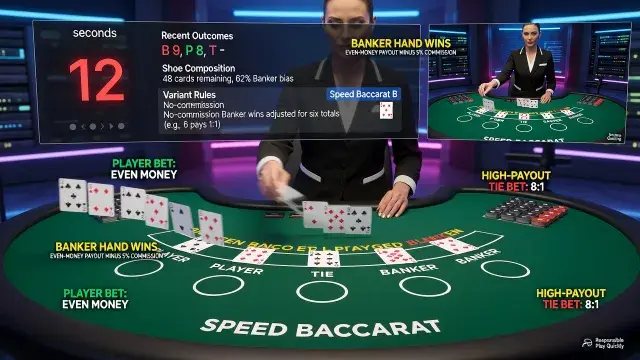
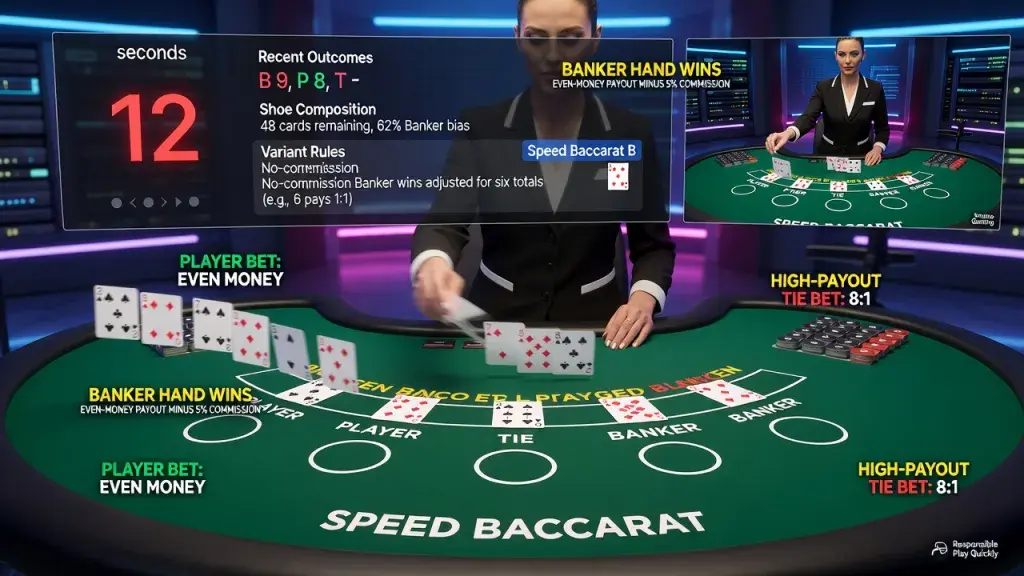
A standard baccarat hand takes roughly a minute to resolve. Speed baccarat cuts that to around thirty seconds, sometimes less. That difference sounds trivial until you sit through a two-hour session and realize you've played nearly double the hands of a traditional table. The mechanics stay the same - banker, player, tie - but the rhythm changes everything about how the game feels and how quickly your bankroll moves.
This shift in pace is exactly why speed baccarat has become a fixture in live casino lobbies rather than a niche curiosity. Dealers skip the ceremonial pauses, card reveals happen almost immediately, and betting windows shrink to a handful of seconds. Some operators have built entire sub-variants around this compressed format - for players curious about one specific ruleset, the speed baccarat b rules govern a version with its own quirks around commission and payout structure. Understanding those distinctions before sitting down matters more than it does at a slower table, because there's less time to course-correct mid-session.
What follows is a practical breakdown of how the format works, where it diverges from classic baccarat, and how to approach it without letting the accelerated pace erode your discipline or your bankroll.
What Is Speed Baccarat and Why It's Gaining Popularity
Speed baccarat is a live-dealer variant built for volume. The core baccarat rules don't change - two hands are dealt, closest to nine wins, and a third-card draw follows a fixed set of conditions. What changes is everything around those rules: shorter betting windows, faster card reveals, and dealers trained to keep the table moving without dead air between rounds.
The Origins of the Fast-Paced Format
Live casino studios introduced speed variants of table games as a direct response to how online players behave differently than land-based ones. Digital players expect fewer lulls and tighter feedback loops. Speed baccarat emerged from that expectation, borrowing the DNA of classic punto banco but stripping out the theatrical pauses that made sense in a physical casino but felt sluggish on a screen.
How It Differs From Traditional Baccarat Tables
The betting circle timer is the most obvious difference - often cut to around ten to fifteen seconds instead of the usual thirty. Card squeezing, a ritual some traditional dealers perform for suspense, is eliminated entirely. Hands are dealt face-up and resolved almost instantly. The payout structure and house edge remain nearly identical to standard baccarat; the difference is purely procedural.
Who Speed Baccarat Appeals To
Players who value efficiency over ceremony gravitate toward this format. It suits those comfortable with the base game already, since there's little time to deliberate on a bet once the round starts. It's less forgiving for newcomers still learning basic baccarat rules, since hesitation at a slow table costs nothing, but hesitation at a speed table can mean missing the betting window entirely.
Speed Baccarat Rules Explained Step by Step
The speed baccarat rules mirror standard punto banco almost exactly. Two hands - Player and Banker - are dealt two cards each. Card values follow the usual system: aces count as one, cards two through nine retain face value, and tens and face cards count as zero. If either hand totals eight or nine on the initial deal, that's a "natural," and no further cards are drawn.
Card Values and Hand Totals
Totals are calculated using only the last digit of the sum. A hand of 7 and 8, for instance, totals fifteen, which becomes five. This modular arithmetic is the backbone of every decision in the game, and it applies identically whether you're at a slow table or a speed one.
The Third-Card Drawing Rules
If neither hand has a natural, a fixed drawing chart determines whether a third card is dealt. The Player hand draws on totals of zero through five and stands on six or seven. The Banker's decision depends on both its own total and the Player's third card, if one was drawn. This chart is not optional or subject to dealer discretion - it's automatic, which is precisely why speed baccarat can move so fast. There's no decision-making involved, only execution.
Betting Options: Player, Banker, and Tie
Three primary bets exist. Banker wins pay even money minus a five percent commission in most versions. Player wins pay even money with no commission. Tie bets pay significantly higher, often eight to one, but carry a much steeper house edge and should be treated as a side novelty rather than a core strategy.
- Banker bet: even money, typically reduced by a 5% commission on wins
- Player bet: even money, no commission
- Tie bet: high payout (commonly 8:1) but a house edge well above the other two options
Speed Baccarat Variations You Should Know
Not all speed baccarat tables run identical rulesets. Studios and operators have introduced variations that tweak commission structures, side bets, or table limits to differentiate their offerings. Knowing which variant you're playing changes how you should approach betting.
Speed Baccarat vs. Speed Baccarat B Rules
The "B" designation typically refers to a variant with an altered commission model - sometimes a no-commission structure on Banker wins that instead pays even money except on a specific winning total, most commonly a six. This shifts the house edge calculation and changes which bet is statistically preferable. Players who default to habits formed on standard tables can misjudge their edge if they don't check which ruleset governs the specific table they've joined.
No-Commission and Super Six Variants
Some tables eliminate the standard five percent Banker commission entirely but reduce the payout on a Banker win by a total of six, paying half or even money depending on the house rule. This changes the math meaningfully. A player relying on Banker bets as a low-variance anchor needs to recalculate expected value under this structure rather than assuming it behaves like classic baccarat.
Multi-Camera and Interactive Speed Tables
Beyond rule variations, presentation differs too. Some speed tables use multiple camera angles and real-time statistics overlays showing recent outcomes, streaks, and pattern trackers. These don't affect the underlying odds - baccarat has no memory between hands - but they do affect player psychology, often encouraging pattern-based betting that has no mathematical basis.
How to Play Speed Baccarat: A Practical Walkthrough
Knowing how to play speed baccarat well starts before the first card is dealt. Preparation matters more here than at a slower table because the margin for adjusting mid-round is almost nonexistent.
Setting Up Your Bankroll for Fast Rounds
Because round frequency roughly doubles compared to standard baccarat, your bankroll depletes or grows at twice the usual rate if bet sizing stays constant. A session bankroll that would last forty rounds at a traditional table might only last twenty at a speed table. Adjust your per-hand stake downward to compensate, or set a strict time limit instead of a hand-count limit.
Reading the Table Interface Quickly
Speed tables compress visual information - betting timers, current shoe statistics, and payout reminders all appear in a smaller window of time. Familiarize yourself with the interface during a low-stakes or demo session before committing real money, so you're not spending precious seconds hunting for the bet button once the clock starts.
Timing Your Bets Before the Window Closes
Betting windows close without warning grace periods in most speed formats. Place your bet as soon as the new round opens rather than waiting to see how you feel about it. Hesitation is the single most common reason new players miss rounds entirely at speed tables.
Fast Baccarat Strategy for Smart, Responsible Play
A fast baccarat strategy isn't about finding a secret edge - none exists in a game this mathematically fixed. It's about protecting your bankroll and decision quality when the pace tempts you into autopilot betting.
Simplified Betting Systems That Work at Speed Tables
Flat betting - wagering the same amount every round regardless of outcome - remains the most sustainable approach at high-frequency tables. Progressive systems like Martingale can spiral quickly when rounds resolve every thirty seconds instead of every minute, doubling your exposure to a losing streak in half the real time.
Avoiding the Trap of Overplaying
The compressed pace of speed baccarat makes it easy to play far more hands than intended, since there's little natural downtime to reassess. Set a hard stop - either a time limit or a loss limit - before you start, and treat it as non-negotiable regardless of how the shoe is running.
Bankroll Management Under Time Pressure
Divide your total session bankroll into fixed units before you sit down, and decide in advance how many units you're willing to lose before stopping. This removes the need to make a rational decision under pressure, which is exactly the situation speed tables create.
- Use flat betting rather than progressive systems at high-frequency tables
- Set a time-based limit, not just a monetary one
- Decide your stop-loss before the first hand, not during a losing streak
Playing Responsibly: Staying in Control at High Speed
The same pace that makes speed baccarat appealing is what makes responsible play harder to maintain. Fewer natural pauses mean fewer moments to reflect on whether your current session still makes sense.
Recognizing When the Pace Is Affecting Your Judgment
If you notice yourself increasing bet size after losses, or betting on tie hands out of frustration rather than strategy, the pace has started to override your judgment. These are reliable signals to step away, at least temporarily.
Practical Limits for Time and Money
Use built-in session timers or reality checks if the platform offers them. Absent that, set an alarm. A firm external cue works better than relying on self-monitoring once you're several rounds deep into a fast-moving shoe.
Using Built-In Tools on Live Casino Platforms
Most reputable live casino operators provide deposit limits, session reminders, and self-exclusion options. These tools matter more at speed tables than standard ones simply because the volume of decisions per hour is higher, and each decision carries real financial weight.
Frequently Asked Questions
Is speed baccarat more profitable than regular baccarat?
No. The house edge and payout structures are essentially identical to standard baccarat. The only meaningful difference is how quickly you're exposed to that edge, since more hands per hour means faster variance in either direction.
Can I use card counting in speed baccarat?
Card counting has minimal effect in baccarat generally, and the compressed timing of speed tables makes it even less practical. The betting window often closes before you'd have time to track and act on shoe composition.
What's the difference between speed baccarat and baccarat b rules specifically?
The "B" variant typically modifies the commission structure, often removing the standard Banker commission but adjusting payouts on specific winning totals like six. This changes the expected value calculation for Banker bets compared to the classic version.
Is speed baccarat suitable for beginners?
It's playable for beginners who already understand basic baccarat rules, but the fast pace leaves little room to learn on the fly. New players benefit from practicing on a standard-speed or demo table first before moving to a speed format.
How much faster is speed baccarat than the standard game?
Rounds typically resolve in about half the time of a traditional table, largely due to shortened betting windows and the removal of dealer rituals like card squeezing.
Does the tie bet make sense as part of a fast baccarat strategy?
Generally no. The tie bet's payout looks attractive, but its house edge is substantially higher than either Player or Banker bets, making it a poor foundation for any sustained betting approach regardless of table speed.