
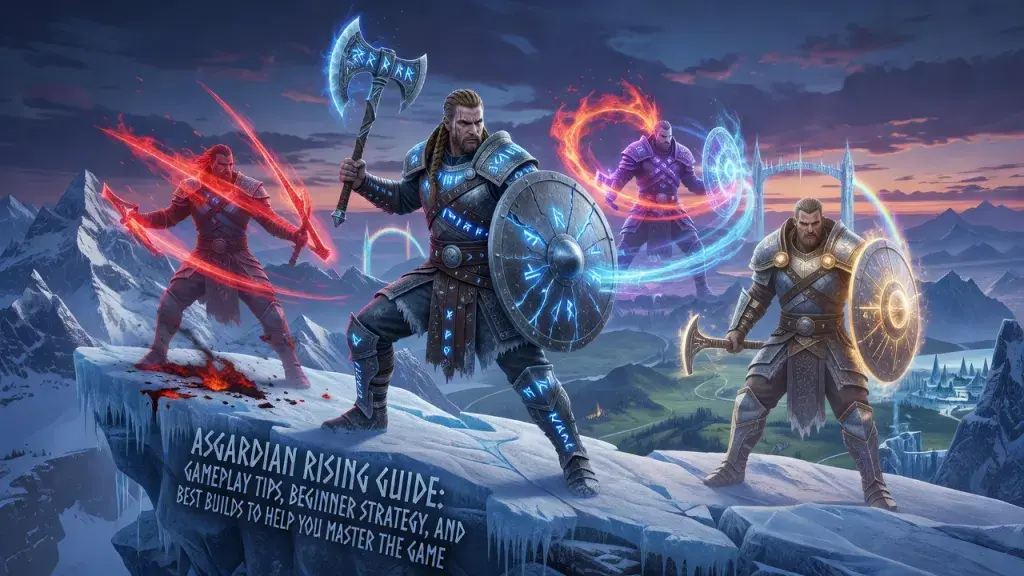
Most new players lose their first ten runs before they understand why. That single detail separates casual dabblers from players who actually progress in Asgardian Rising: the early game punishes guesswork, and it rewards anyone willing to study the systems underneath the surface. The mechanics look approachable at first glance - a linear path of encounters, familiar resource bars, recognizable combat prompts - but the depth reveals itself once difficulty scales and the margin for error shrinks.
What separates a smooth climb through the ranks from a frustrating grind is knowledge you won't get from trial and error alone. Combat timing, resource allocation, and build synergy all interact in ways that aren't obvious from the tutorial. Before jumping into specific builds, it helps to understand exactly how to play Asgardian Rising at a mechanical level, because builds only work when the fundamentals underneath them are solid. This guide breaks down the systems piece by piece, starting with what the game actually asks of you and ending with the exact strategies experienced players rely on to stay ahead.
Whether you're three hours in and stuck on a wall or completely new and trying to avoid early mistakes, this Asgardian Rising guide covers the terrain methodically - mechanics first, strategy second, builds last, because that order mirrors how mastery actually develops.
What Is Asgardian Rising and Why Players Are Talking About It
Asgardian Rising sits in a genre crowded with imitators, yet it distinguishes itself through a combat system that punishes passive play and rewards players who actively read enemy patterns. Instead of a simple gear-check progression loop, the game layers timing-based mechanics on top of traditional stat growth, which means two characters with identical equipment can perform completely differently depending on player skill.
Core Concept and Setting
The game draws from Norse-inspired mythology without leaning on it as a crutch. Realms, factions, and enemy types are built around distinct combat philosophies rather than cosmetic themes alone - a frost-aligned enemy genuinely behaves differently than a fire-aligned one, forcing players to adjust tactics rather than just swap resistances.
Why It Stands Out From Similar Titles
Where comparable games often gate progress behind repetitive grinding, Asgardian Rising ties advancement to mechanical understanding. Players who master dodge windows and resource timing progress noticeably faster than those who simply farm levels, which shifts the skill ceiling higher than genre norms.
Who This Guide Is For
This breakdown serves two groups: newcomers who want a clean entry point without wasted hours, and intermediate players stuck at a plateau who need sharper Asgardian Rising gameplay tips to break through. Veteran players optimizing endgame builds will find the later sections most relevant.
How to Play Asgardian Rising: Core Mechanics Explained
Before any strategy makes sense, the base mechanics need to click. Combat, resource management, and progression form three interlocking systems, and weakness in any one of them undermines the other two.
Combat Fundamentals and Timing Windows
Every enemy telegraphs its attacks with a visual cue a fraction of a second before impact. Learning these cues by enemy type, rather than reacting generically, is the single biggest skill jump available to new players. Dodging too early leaves you vulnerable to follow-up attacks; dodging too late means eating full damage.
Resource Management: Stamina, Mana, and Cooldowns
Stamina governs physical actions, mana fuels abilities, and cooldowns gate your strongest tools. Spending all three recklessly in the opening seconds of a fight is the most common beginner mistake, because it leaves nothing in reserve for the harder second half of most encounters.
Progression Systems and Unlock Pacing
Character growth follows a layered system: base stats increase through leveling, while gear and skill trees add situational power. Understanding which layer to prioritize at which stage prevents wasted resources on upgrades that won't matter once you outlevel them.
- Watch enemy attack animations before committing to offense
- Reserve at least 20-30% of stamina during extended fights
- Prioritize skill unlocks that synergize with your current gear over generic stat boosts
Asgardian Rising Beginner Strategy: Avoiding Common Mistakes
New players tend to repeat the same errors, and almost all of them stem from treating the game like a simpler title than it actually is.
Early-Game Priorities That Actually Matter
Rushing main story content before building a stable resource loop leaves players underpowered against mid-game bosses. A smarter Asgardian Rising beginner strategy focuses on completing side objectives that grant permanent stat bonuses before pushing story progression too aggressively.
Mistakes That Slow Down Progress
Overspending currency on early-tier gear that gets replaced within a few hours wastes resources that matter more later. Similarly, ignoring enemy elemental types and relying on one damage style creates unnecessary difficulty spikes that better preparation would avoid.
Building Sustainable Habits From Hour One
Establishing a consistent upgrade rhythm - spending resources on gear, skills, and consumables in a fixed ratio rather than impulsively - creates compounding advantages. Players who track this rhythm during their first sessions rarely hit the frustrating walls that cause others to quit early.
Best Builds for Asgardian Rising: Choosing Your Playstyle
Once fundamentals are solid, build selection determines how efficiently you clear content. There's no single dominant build, but there are clear archetypes that reward specific playstyles.
Aggressive Damage Builds for Fast Clears
These builds maximize burst damage at the cost of survivability, ideal for players confident in their dodge timing. Stacking offensive stats and cooldown reduction lets skilled players end fights before defensive weaknesses become relevant.
Defensive and Sustain-Focused Builds
For players still refining reaction timing, sustain builds prioritize health regeneration and damage mitigation. These builds trade clear speed for consistency, making them the safer choice while learning enemy patterns.
Hybrid Builds for Balanced Progression
Most experienced players eventually settle into a hybrid approach, balancing offense and defense based on the specific challenge ahead. Among the best builds for Asgardian Rising, hybrids tend to age best because they adapt to shifting difficulty rather than committing to one extreme.
Adjusting Builds for Boss Fights vs. Regular Encounters
Static builds underperform against bosses with unique mechanics. Swapping gear and skill loadouts before major fights, rather than relying on a single all-purpose setup, consistently outperforms rigid builds in difficulty spikes.
Advanced Asgardian Rising Gameplay Tips for Long-Term Mastery
Once the basics and builds are in place, small refinements separate competent players from exceptional ones.
Reading Enemy Patterns at Higher Difficulty
Higher-tier enemies combine attack patterns in ways that punish memorized routines. Staying observant rather than relying purely on muscle memory keeps players adaptable as difficulty scales.
Optimizing Gear Synergies Rather Than Raw Stats
Two items with lower individual stats but strong synergy often outperform higher-rated gear used in isolation. Testing combinations rather than chasing numerical upgrades pays off significantly at higher levels.
Efficient Resource Farming Without Burnout
Sustainable farming routines, focused on specific high-value encounters rather than repetitive low-reward grinding, keep progression steady without draining player motivation.
Frequently Asked Questions
What's the fastest way to improve at combat as a beginner?
Focus entirely on learning enemy attack animations before worrying about damage output. Once dodge timing becomes instinctive, damage and build optimization become far easier to layer on top.
Should I commit to one build early or experiment?
Experiment during the first several hours. Committing too early to a single build style before understanding enemy variety often forces a frustrating respec later.
How much should I prioritize side content versus the main story?
Side content that grants permanent stat bonuses should generally come before pushing story progression too far. Skipping it creates avoidable difficulty spikes in mid-game encounters.
Are hybrid builds better than specialized ones?
Hybrid builds offer more consistency across varied content, while specialized builds excel in narrow scenarios like speed-clearing familiar encounters. Choose based on whether you value adaptability or peak efficiency.
What's the biggest mistake new players make with resources?
Overspending stamina and mana in the opening moments of a fight, leaving nothing for the harder later phases. Reserve a portion of both resources at all times, especially in longer encounters.
Do I need to change my build for every boss fight?
Not every fight, but major bosses with unique mechanics usually reward a tailored loadout. Keeping a flexible gear rotation ready saves significant frustration compared to relying on one fixed build.